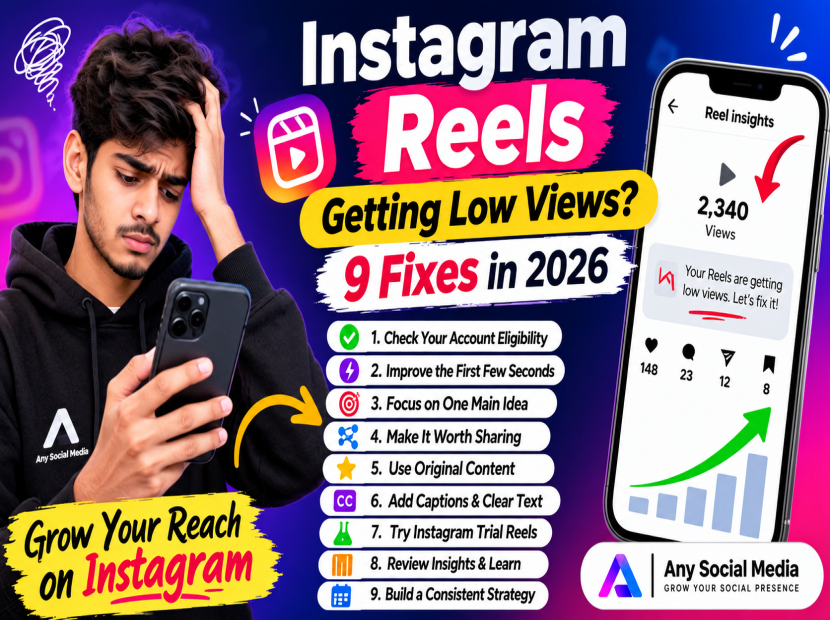
Instagram Reels Getting Low Views? 9 Fixes (2026)
Publishing Instagram Reels consistently but still getting very few views? Low reach can be frustrating, especially when you spend time planning, recording and editing each video. Before assuming that your account is shadowbanned or that Instagram has stopped recommending your content, investigate what is actually happening.
Instagram Reels can receive different levels of distribution depending on the content, audience response, recommendation eligibility and other ranking signals. There is no single trick that guarantees more views. The practical approach is to identify where your content is underperforming, test specific improvements and learn from the results.
In this guide, Any Social Media explains nine practical ways to diagnose low Instagram Reels views in 2026, improve the viewing experience and build a more consistent content strategy.
Quick Answer: Why Are Your Instagram Reels Getting Low Views?
Instagram Reels may receive low views for several reasons, including an unclear opening, content that does not match audience interests, weak viewer retention, limited shareability, recommendation eligibility issues or an inconsistent content strategy. Low views alone do not prove that an account is shadowbanned.
Start by checking your account status and Reel insights. Then improve the opening seconds, focus on one clear idea, create original content, make the video understandable without sound, test different formats and compare results over multiple posts.
1. Check Whether Your Account and Content Are Eligible for Recommendations
Before changing your editing style or posting schedule, check whether Instagram can recommend your content to people who do not follow you.
Instagram has recommendation guidelines that are separate from its general Community Guidelines. Content being allowed on Instagram does not automatically mean it is eligible for every recommendation surface.
To investigate:
- Open your Instagram profile and access the account settings.
- Look for Account Status and review any notices or restrictions shown.
- Check whether Instagram indicates that your content or profile may be ineligible for recommendations.
- If a restriction appears, read the explanation and follow the available review or correction process.
- Review the official Instagram guidance on recommendations and applicable content policies.
Do not assume that low views automatically mean a shadowban. A Reel can perform poorly even when an account has no recommendation restrictions.
Official resource: Instagram Help Center.
2. Improve the First Few Seconds of Your Reel
Your opening should quickly communicate why someone should keep watching. If the viewer cannot understand the subject or benefit, the video may lose their attention before the main point appears.
Avoid spending too much time on greetings, logos, lengthy introductions or unrelated footage when the viewer expects a quick answer.
For example, a creator making a coding Reel could open with:
- Weak opening: "Hello everyone, welcome back to my channel. Today I am going to explain something interesting."
- Clearer opening: "Still confused about Java loops? Here is the difference in 20 seconds."
The stronger opening identifies the audience, the problem and the value of watching. It does not need exaggerated claims or misleading clickbait.
Try a simple hook formula
Audience problem + specific promise + relevant demonstration.
For example: "Editing Reels on your phone? Try this simple way to make captions easier to read."
Keep the promise realistic and deliver the information immediately. A hook that attracts attention but fails to deliver can disappoint viewers.
3. Focus on One Main Idea Instead of Too Many Topics
A Reel usually works better as a focused piece of communication than as a collection of unrelated tips. When a short video attempts to explain too many things, viewers may struggle to follow the message.
Before recording, complete this sentence:
"After watching this Reel, the viewer should understand or be able to do ______."
If you cannot complete that sentence clearly, narrow the topic.
For example, instead of creating one Reel about Instagram growth, hashtags, video editing, captions and posting times, create separate videos about each topic. Each video can answer one question and lead interested viewers to related content.
This also makes it easier to evaluate performance because you can compare similar topics and identify which ones resonate with your audience.
4. Make the Reel Worth Finishing, Saving or Sharing
Views are only one part of content performance. A creator should also consider whether viewers watch the video, share it with someone, save it for later or visit the profile.
Instagram has explained that its ranking systems use multiple predictions and signals to estimate what people may find relevant. No single metric guarantees distribution.
Consider these content formats:
- Useful tutorials: Demonstrate a task step by step.
- Specific answers: Solve one common audience question.
- Before-and-after explanations: Show a genuine process and explain what changed.
- Checklists: Give viewers a practical reference they may want to save.
- Relatable experiences: Describe a real problem and what you learned from it.
Do not ask people to share or comment without a meaningful reason. Give them something worth discussing or passing along.
Official background: How Meta explains AI ranking on Facebook and Instagram.
5. Use Original Content That Fits Your Audience
Copying another creator's Reel, changing a few words or reposting a video with little additional value is not a reliable content strategy. Develop your own explanation, examples, storytelling and visual presentation.
Originality does not mean that every subject must be completely new. Many creators discuss the same topics successfully because they bring a different perspective, useful experience or clearer explanation.
To make a familiar topic more original:
- Use your own footage, demonstrations or screen recordings.
- Explain a lesson you learned from a genuine experience.
- Include a specific example instead of repeating generic advice.
- Rewrite scripts in your natural speaking style.
- Add context or analysis when discussing a trend.
- Use third-party material only when you have the necessary rights and permissions.
Instagram's recommendation guidance identifies certain low-quality or unoriginal publishing practices as potential concerns. Review the current official guidance instead of relying on viral claims about the algorithm.
Reference: Instagram Help Center.
6. Make Your Reel Easy to Understand Without Sound
Some viewers watch videos in environments where audio is inconvenient or unavailable. Clear on-screen text and captions can make your message easier to follow.
Use these practical checks:
- Add accurate captions when you speak.
- Keep important text large enough to read on a phone.
- Use sufficient contrast between text and background.
- Avoid covering important content with interface elements.
- Remove unnecessary visual clutter.
- Keep background music at a level that does not overpower speech.
Captions do not guarantee additional reach, but they can improve accessibility and help viewers understand the message.
Review your finished video on a phone before publishing. If the main point is difficult to understand without replaying the video several times, simplify the presentation.
7. Test Instagram Trial Reels If the Feature Is Available
Trial Reels can help eligible creators test content with people who do not follow them before deciding whether to share it with their wider audience.
Meta introduced Trial Reels as a way for creators to experiment with topics and formats, assess performance and reduce the uncertainty involved in trying new ideas.
A practical testing process is:
- Choose a topic that is relevant to your target audience.
- Create a Reel with one clear message.
- If Trial Reels is available for your account, publish the test using the Trial option.
- Review the available performance metrics after sufficient time has passed.
- Compare the result with your previous tests and decide whether to share the Reel more widely or revise the idea.
Test meaningful differences, such as the opening hook, the explanation or the presentation style. Avoid changing everything at once because it becomes difficult to understand what affected the result.
Trial Reels are not a guaranteed route to viral reach, and availability or features may vary. Check Instagram's current interface and guidance.
Official source: Meta's announcement about Trial Reels.
8. Review Insights Instead of Guessing
When Reels views are low, publishing more videos without reviewing the results may repeat the same problems. Use Instagram Insights, where available, to understand how people respond to each Reel.
Look at the metrics that match your objective:
- Views and reach: Help you understand video exposure and the number of accounts reached, where reported.
- Watch time and retention: Help identify whether people continue watching or leave early, depending on the metrics available.
- Shares and saves: Help indicate whether viewers find the content useful or worth passing along.
- Profile activity: Helps assess whether the Reel encourages people to explore your account.
- Follows and website activity: Help evaluate whether attention leads to a meaningful next step, when those metrics are available.
Do not judge a Reel using only its view count. A tutorial that reaches fewer people but attracts the right audience may be more valuable to a creator or business than a high-view video that produces no meaningful interest.
A simple Reel performance review
After publishing, record the topic, opening hook, format and available metrics. Compare results with your own recent Reels rather than relying on an arbitrary universal benchmark.
Views alone do not tell the whole story. Review engagement alongside other available Reel insights to better understand how viewers respond to your content. You can use our Instagram engagement rate calculator to explore engagement metrics for your public profile.
If viewers leave early, experiment with a clearer opening or tighter editing. If people watch but do not visit your profile, review whether your profile and call to action explain what they can expect next. If a topic consistently attracts relevant engagement, explore related questions in future posts.
9. Build a Consistent, Sustainable Publishing System
Consistency makes it easier to learn what your audience responds to, but publishing more often does not automatically produce more views. Choose a schedule that allows you to maintain content quality and review performance.
Here is an example of a seven-day experiment:
| Day | Action | Purpose |
|---|---|---|
| 1 | Review recent Reels and account status | Identify potential issues |
| 2 | Create a focused tutorial | Test a clear, useful topic |
| 3 | Publish a Reel with a different opening | Test how the message is introduced |
| 4 | Review available insights | Identify audience response patterns |
| 5 | Publish a practical checklist or demonstration | Test usefulness and shareability |
| 6 | Respond to genuine audience questions | Discover relevant content ideas |
| 7 | Compare the results and plan the next test | Improve the next batch of content |
This is an example experiment, not a promise that views will increase within seven days. Some videos need more time to collect useful data, and results can vary significantly by account, topic and audience.
Common Myths About Low Instagram Reels Views
Myth 1: Every low-view Reel means your account is shadowbanned
Reality: Low views alone do not establish that an account is restricted. Check Account Status and review actual performance data before drawing conclusions.
Myth 2: Adding more hashtags guarantees more views
Reality: Hashtags are not a guaranteed reach strategy. Use relevant labels when appropriate, but prioritize clear topics and content that serves the intended audience.
Myth 3: Posting at one specific time guarantees viral reach
Reality: Posting time can affect who is available to watch, but no universal time guarantees performance. Use your own audience insights to test suitable publishing windows.
Myth 4: Buying views guarantees organic growth
Reality: A higher view count does not guarantee genuine followers, meaningful engagement, sales or wider recommendation. Artificial engagement may also conflict with platform policies. Prioritize authentic audience development and understand the risks of any third-party service.
How to Build a Better Instagram Content Strategy
Fixing one Reel is useful, but sustainable improvement comes from learning across multiple posts. Start by defining the audience, selecting a relevant topic and choosing one objective for each video.
If you need a broader plan, read our Instagram Marketing Guide for 2026 for profile optimization, content planning and audience engagement.
You can also explore our Social Media Marketing Guide for Beginners to understand how content, distribution and measurement work together across platforms.
If you are comparing third-party social media services, our guide to what an SMM panel is explains how such services work and why buyers should review service terms, delivery expectations and platform policies before ordering.
Frequently Asked Questions
Why are my Instagram Reels getting low views in 2026?
Possible reasons include an unclear opening, a topic that does not match audience interests, weak viewer retention, limited shareability or recommendation eligibility issues. Review Account Status and available insights before deciding what to change.
How do I fix Instagram Reels that are not getting views?
Check recommendation eligibility, improve the opening, focus on one useful idea, make the video easy to understand, create original content and compare performance across multiple posts. No single fix works for every account.
Does Instagram shadowban accounts with low views?
Low views alone are not proof of a shadowban. Review Account Status and any notices Instagram provides. If you see a restriction, follow the platform's instructions to understand or address it.
Do hashtags increase Instagram Reels views?
Relevant hashtags can describe a video's topic, but they do not guarantee additional views. Avoid unrelated tags and focus on clear content, audience relevance and useful captions.
Are Instagram Trial Reels useful for small creators?
Trial Reels can help eligible creators test content with non-followers and review available metrics before deciding whether to share it more widely. Results vary, and the feature does not guarantee increased reach.
Should I delete a Reel that gets very few views?
Not automatically. Review the content, its objective and the available insights first. Deleting a Reel immediately may remove an opportunity to learn from its performance. Consider whether it contains an actual error or needs a meaningful correction.
How many Reels should I post each week?
There is no universal posting frequency that guarantees growth. Start with a realistic schedule you can sustain while maintaining quality. Use your own results to decide whether to increase, reduce or change your publishing frequency.
Can buying Instagram views make my Reels go viral?
No service can guarantee viral reach, genuine followers or sales. Paid or artificial views may not represent real audience interest, and some methods may violate platform policies. Evaluate any third-party service carefully and do not treat views as a substitute for a strong content strategy.
Final Thoughts
Instagram Reels getting low views is a problem to investigate, not a reason to immediately blame the algorithm. Check your recommendation eligibility, improve how quickly your video delivers value, publish original content and use insights to understand what your audience responds to.
Test one improvement at a time, compare results over multiple posts and keep the strategy that provides meaningful value to your intended audience. There is no guaranteed shortcut to viral reach, but a disciplined process gives you better information for making your next content decision.
Explore more practical social media marketing resources at Any Social Media.
Editorial note: Platform features and recommendation guidance can change. Verify current settings and policies in Instagram before applying a recommendation.