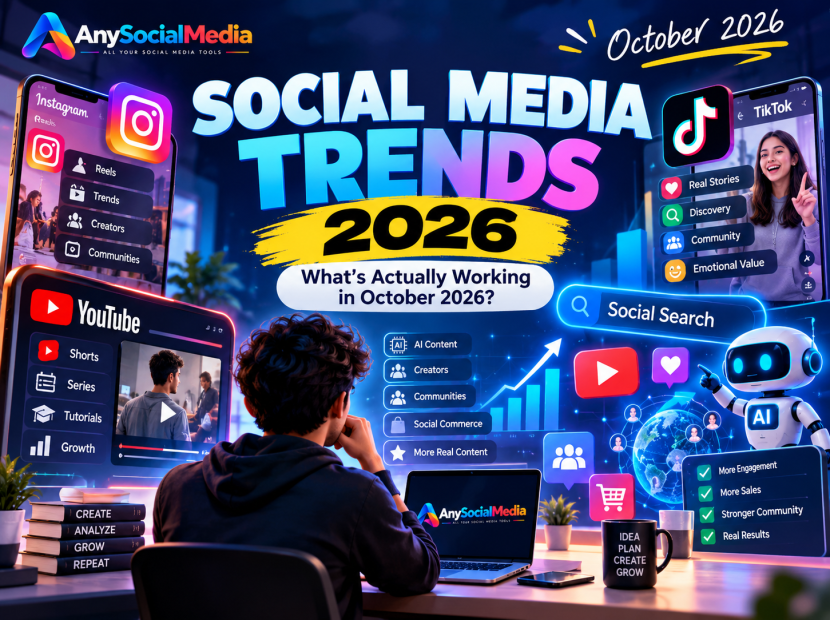
Social Media Trends 2026: What’s Actually Working in October?
Social Media Trends 2026: What’s Actually Working in October 2026?
Social media is changing faster than ever.
The strategies that worked a few years ago—posting randomly, chasing followers, copying viral sounds, and publishing highly polished promotional content—are becoming less reliable.
In 2026, social platforms are increasingly acting as search engines, recommendation systems, entertainment platforms, shopping destinations, and communities at the same time.
For creators and businesses, the biggest question is no longer:
“How often should I post?”
The better question is:
“Why should someone stop, watch, save, share, search for, or trust my content?”
This guide covers the most important social media trends in October 2026, what they mean for Instagram, TikTok, YouTube and other platforms, and how businesses can adapt their social media marketing strategy.
Quick Answer: What Are the Biggest Social Media Trends in 2026?
The biggest social media trends shaping October 2026 are:
- Social media is becoming a search engine
- AI is becoming part of the content workflow
- Authentic human content is becoming more valuable
- Short-form video is evolving into series and episodes
- Creators and communities are influencing purchasing decisions
- Useful content is beating empty promotional content
- Niche audiences are becoming more valuable than mass audiences
- Brands are behaving more like creators
- Social commerce is shortening the path from discovery to purchase
- Content needs to work across multiple discovery systems
In 2026, successful social media marketing is increasingly focused on discovery, community, authenticity and useful content.
1. Social Media Is Becoming a Search Engine
One of the biggest changes in social media marketing is the growth of social search.
People are increasingly using platforms such as TikTok, Instagram and YouTube to find:
- Product recommendations
- Tutorials
- Reviews
- Restaurants
- Travel ideas
- Technology advice
- Fitness information
- Educational content
- How-to answers
- Comparisons
This means social media content should not only be entertaining—it should also be discoverable.
For example, instead of creating a Reel titled:
“My New Phone 😍”
A creator could create:
“Best Android Phones Under ₹30,000 in 2026”
The second topic has a clear search intent.
How to Optimize Content for Social Search
Use important keywords naturally in:
- Video titles
- Captions
- On-screen text
- Spoken dialogue
- Descriptions
- Hashtags
- FAQs
Don't stuff keywords everywhere. Create content that directly answers questions people are actually asking.
2. AI Is Becoming a Content Assistant, Not a Replacement for Creativity
AI is now deeply integrated into the social media workflow.
Creators and marketers can use AI for:
- Content ideas
- Research
- Script creation
- Caption generation
- Translation
- Editing
- Thumbnail concepts
- Audience analysis
- Content repurposing
- Performance analysis
But there is an important difference between AI-assisted content and AI-generated content with no human value.
The first can make creators faster.
The second can make content feel repetitive.
The strongest approach in 2026 is:
Human idea + AI assistance + human experience + human editing
For example:
Bad Workflow
AI generates 30 generic posts and the creator publishes everything without adding personal experience.
Better Workflow
Creator identifies an audience problem → AI helps with research and structure → creator adds personal experience → content is edited and published.
AI should increase your creative output—not remove your personality.
3. Authenticity Is Becoming a Competitive Advantage
As AI-generated content becomes easier to produce, genuinely human content can become more noticeable.
Audiences increasingly want:
- Real experiences
- Opinions
- Behind-the-scenes content
- Personal stories
- Mistakes and lessons
- Product demonstrations
- Real people
- Unscripted moments
This does not mean professional content is dead.
It means professional + human can be more powerful than perfect + artificial.
A Simple Rule
Don't ask:
“How can I make this look perfect?”
Ask:
“How can I make this feel real?”
4. Short-Form Video Is Evolving Into Series
Short-form video is not disappearing.
But the format is evolving.
Instead of creating completely unrelated Shorts or Reels, creators can build:
- Episodes
- Series
- Challenges
- Tutorials
- Stories
- Case studies
- Progress journeys
- Multi-part explanations
YouTube has introduced Shorts series, allowing creators to structure Shorts into seasons and episodes. This creates new opportunities for creators to build recurring content and encourage viewers to return.
Example
Instead of:
“Java DSA Tip #1”
Try:
“30 Days of Java DSA — Day 1”
Then continue with:
- Day 2
- Day 3
- Day 4
- Day 5
Now every video becomes part of a larger journey.
This can encourage viewers to return for the next episode.
5. Educational Content Is Becoming More Important
Entertainment can generate attention.
But useful information can generate trust.
In 2026, creators and businesses can benefit from educational formats such as:
- Tutorials
- Step-by-step guides
- Mistakes to avoid
- Comparisons
- Case studies
- Product explainers
- Industry updates
- Quick lessons
For example, a social media marketing company shouldn't only post:
“Buy our services today.”
It could publish:
“5 Reasons Your Instagram Reels Are Getting Low Reach”
The audience gets value first.
The business can then introduce its service naturally.
6. Creator-Led Marketing Is Becoming More Powerful
Influencer marketing is changing.
Brands are increasingly looking beyond celebrity creators and focusing on creators who have:
- Relevant audiences
- Strong communities
- Credibility
- Consistent engagement
- Expertise
- A recognizable personality
The right creator doesn't necessarily have millions of followers.
A creator with 20,000 highly relevant followers can sometimes be more valuable than a creator with 2 million followers and weak audience relevance.
What Businesses Should Look For
Don't only evaluate:
Followers
Also evaluate:
- Audience relevance
- Average views
- Engagement quality
- Comments
- Saves
- Shares
- Content quality
- Conversion potential
- Brand fit
7. Communities Are More Valuable Than Just Followers
Follower count is easy to display.
Community is harder to build.
A community is made up of people who:
- Recognize your brand
- Return regularly
- Participate in discussions
- Share your content
- Recommend you to others
- Trust your opinions
This is why comments, shares, saves, DMs and meaningful conversations matter.
Build a Community By:
- Asking useful questions
- Replying to comments
- Creating recurring content
- Featuring audience responses
- Running challenges
- Creating private groups
- Sharing behind-the-scenes content
Don't build an audience that only watches.
Build an audience that participates.
8. Social Commerce Is Becoming More Important
Social media is increasingly influencing the entire purchase journey.
A customer may:
- Discover a product on TikTok
- Watch a creator review it
- Search for alternatives on Instagram
- Watch YouTube reviews
- Compare prices
- Purchase online
This means social media is no longer just a traffic source.
It can become part of the discovery → research → trust → purchase process.
For Brands
Don't just show the product.
Show:
- How it works
- Who needs it
- What problem it solves
- Real use cases
- Comparisons
- Customer experiences
- Frequently asked questions
People don't only want to know what you're selling.
They want to know why they should care.
9. Brands Are Starting to Behave Like Creators
Traditional corporate social media often looks like:
Announcement → Product → Promotion → Repeat
Creator-style brands work differently.
They use:
- Personality
- Humor
- Trends
- Stories
- Opinions
- Educational content
- Community interaction
- Behind-the-scenes content
The goal isn't to turn every brand into a comedian.
The goal is to make the brand feel human and relevant.
A technology company can explain complicated technology simply.
A fashion brand can show styling experiments.
A SaaS company can share customer stories.
A social media platform can teach users how to grow online.
10. Content Quality Matters More Than Content Quantity
Publishing 10 low-value posts isn't automatically better than publishing three useful posts.
Before publishing anything, ask:
Does This Content Provide at Least One of These?
- Information
- Entertainment
- Inspiration
- Utility
- Emotion
- A new perspective
- A solution
If the answer is no, the content probably needs improvement.
The goal in 2026 isn't:
Post more.
The goal is:
Make every post worth someone's attention.
Instagram Trends in 2026
Instagram remains important for creators and businesses, but content needs to be designed around discovery rather than only existing followers.
Focus on:
- Reels
- Search-friendly captions
- Carousels
- Educational content
- Creator collaborations
- Stories
- Community interaction
- Original content
- Strong hooks
A useful Instagram strategy is to create content for both:
Existing followers + people who have never heard of you.
That means every post should make sense even when someone discovers it for the first time.
TikTok Trends in 2026
TikTok's 2026 direction highlights several important themes around discovery, authenticity, community and meaningful content.
Real Stories and Human Connection
Audiences are looking for real stories, relatable experiences and human connection.
Curiosity-Driven Discovery
People increasingly use TikTok for discovery and search, often finding useful information beyond their original query.
Emotional Value
Consumers increasingly want to understand why a product, service or experience is actually worth their money and attention.
For brands, this means content should feel less like advertising and more like useful participation in the audience's world.
YouTube Trends in 2026
YouTube is becoming increasingly flexible across short-form and long-form content.
One of the most interesting developments is Shorts series.
Creators can structure Shorts into seasons and episodes, making episodic storytelling easier.
This creates opportunities for:
- Educational series
- Mini-documentaries
- Tutorials
- Microdramas
- Challenges
- Product stories
- Interview series
- Day 1 to Day 30 journeys
What Should Businesses Do in 2026?
A strong social media strategy doesn't require being everywhere.
Step 1: Choose Your Primary Platform
Choose the platform where your target audience already spends time.
Step 2: Define Three Content Pillars
For example:
Education + Proof + Personality
Step 3: Create One Strong Idea
Don't immediately create separate ideas for every platform.
Start with one valuable idea.
Step 4: Repurpose Intelligently
Turn one idea into:
- YouTube video
- YouTube Short
- Instagram Reel
- Instagram carousel
- LinkedIn post
- X post
- Blog article
Step 5: Analyze the Results
Track:
- Watch time
- Retention
- Shares
- Saves
- Comments
- Profile visits
- Website clicks
- Leads
- Sales
Don't judge content only by likes.
A Simple 30-Day Social Media Strategy
Week 1: Research
Identify:
- Audience problems
- Frequently asked questions
- Competitors
- Trending topics
- Search queries
- Existing high-performing content
Week 2: Create
Produce:
- 3–5 short videos
- 2 educational posts
- 1 deeper piece of content
- 1 community-focused post
Week 3: Test
Test different:
- Hooks
- Video lengths
- Titles
- Thumbnails
- Topics
- Calls to action
Week 4: Double Down
Find the top-performing content.
Then create more content around the same topic from different angles.
For example:
Original: “Best social media marketing strategy for beginners”
- 5 mistakes beginners make
- How to create a social media calendar
- How to grow without paid ads
- Best content ideas for beginners
- 30-day social media challenge
One successful topic can become an entire content ecosystem.
What Is Fading in 2026?
Buying Fake Engagement
Fake followers may increase a number but don't create a real audience.
Copying Every Viral Trend
A trend isn't automatically useful for your brand.
Posting AI-Generated Content Without Editing
AI can accelerate content production, but generic content can make your brand look interchangeable.
Focusing Only on Followers
A smaller but highly engaged audience can be more valuable.
Posting Without a Purpose
Every post should have a reason.
The 2026 Social Media Formula
A simple framework for creators and businesses is:
Discovery + Value + Personality + Trust + Community
Discovery
Make your content searchable and recommendation-friendly.
Value
Teach, entertain, solve or inspire.
Personality
Give people a reason to remember you.
Trust
Use real examples, evidence and experiences.
Community
Turn viewers into participants.
This is much stronger than simply trying to “go viral.”
Final Thoughts
Social media in 2026 is not simply about getting more followers.
It is becoming an ecosystem where people search, discover, learn, compare, communicate and buy.
AI will continue to make content creation faster.
But speed alone won't create a strong brand.
The creators and businesses that stand out will combine AI efficiency with human creativity, useful information, authentic experiences and strong communities.
The biggest opportunity is not to predict every algorithm change.
It is to build content that remains valuable even when the algorithm changes.
Create for people first. Optimize for discovery second. Use AI to move faster—but keep the human idea at the center.
Frequently Asked Questions
What are the biggest social media trends in 2026?
The biggest trends include social search, AI-assisted content creation, authentic content, short-form video series, creator-led marketing, niche communities, social commerce and educational content.
Is AI-generated content good for social media?
AI can be extremely useful for research, ideation, editing and production. However, completely generic AI-generated content can lack originality. The strongest approach combines AI assistance with human creativity and experience.
Is short-form video still important in 2026?
Yes. Short-form video remains important, but the format is evolving. Platforms are increasingly supporting structured series, episodic storytelling and longer viewing journeys.
Should businesses focus on followers or engagement?
Businesses should look beyond follower count. Meaningful engagement, audience relevance, website visits, leads, sales and customer relationships can provide a better picture of social media performance.
Is social media replacing Google?
Social media is not completely replacing traditional search. However, platforms such as TikTok, Instagram and YouTube are increasingly being used for discovery, recommendations and product research.
How often should I post on social media?
There is no universal number. A sustainable schedule with useful, consistent content is generally better than publishing large amounts of low-quality content.
What is the best social media strategy for 2026?
Focus on searchable content, short-form video, educational value, authentic storytelling, creator collaborations and community building. Then measure the results and create more content around what works.
Key Takeaway
The future of social media isn't about creating more content. It's about creating content that people actually want to discover, watch, save, share and trust.